Data Fiduciary vs Data Processor Under the DPDP Act
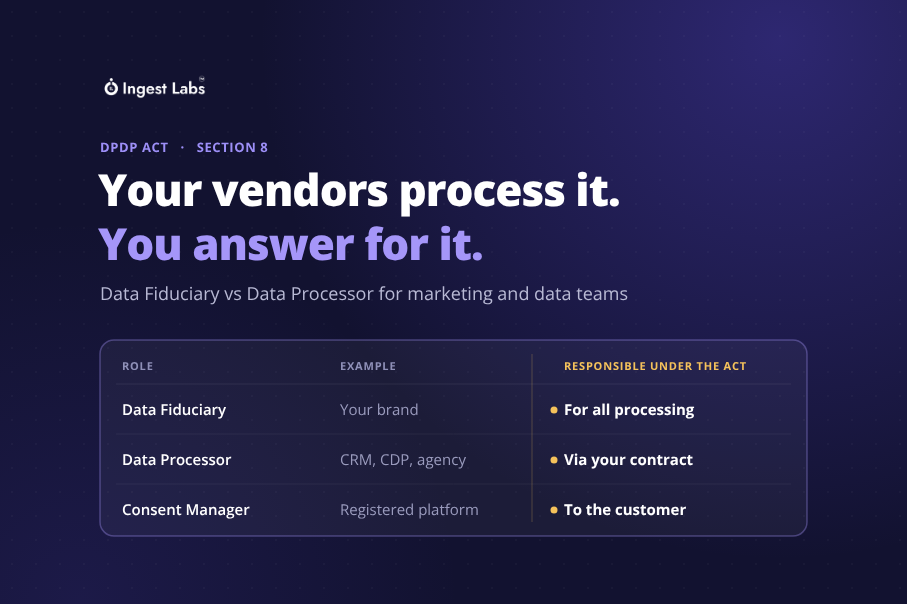
Short answer: Under India's DPDP Act, a Data Fiduciary decides why and how personal data is processed; a Data Processor processes it on the fiduciary's behalf. The Act puts almost all of its obligations on the fiduciary, and section 8(1) makes the fiduciary responsible for everything its processors do on its behalf, regardless of any contract that says otherwise. The fiduciary may use a processor only under a valid contract, must protect data held by its processors, and must cause them to stop processing when consent is withdrawn and to erase data when it should be erased. Whether a vendor is your processor or a fiduciary in its own right depends on who decides the purposes, not on what the contract calls it. Most of these obligations apply from 13 May 2027.
Every DPDP programme eventually reaches the vendor list. A large Indian brand typically shares customer data with an ad agency, a CRM, an email platform, a customer data platform, analytics tools, ad platforms, a call-centre partner, payment and logistics providers and a cloud host. Some of these act purely on your instructions. Others use the data for their own purposes as well.
The Digital Personal Data Protection Act, 2023 has two roles for this: Data Fiduciary and Data Processor. Getting the classification right decides who answers to the Data Protection Board, what your contracts need to say, and how withdrawal, erasure and breach reporting have to work across your stack.
This article explains the two roles, what the Act requires of each, how to classify common marketing and data vendors, and what to put in your processor contracts before 13 May 2027. For the full timeline, see our DPDP Act compliance guide.
The two definitions
Section 2 of the Act defines both roles in a single line each.
-
Data Fiduciary (section 2(i)): "any person who alone or in conjunction with other persons determines the purpose and means of processing of personal data".
-
Data Processor (section 2(k)): "any person who processes personal data on behalf of a Data Fiduciary".
Three things follow from the wording.
First, in our reading the test is functional. A vendor whose contract says "processor" but which decides to use your customers' data to train its own models or build its own audiences is deciding a purpose of its own. For that processing, it is likely to be acting as a fiduciary.
Second, the phrase "alone or in conjunction with other persons" means two organisations can be fiduciaries for the same processing. A co-branded credit card programme, where the bank and the retailer each decide how the cardholder data is used, is, in our view, a typical example.
Third, one organisation can hold both roles in different relationships. An agency is your processor when it runs your campaigns on your data, and a fiduciary for its own staff and its own new-business marketing.
What the Act requires of each
The DPDP Act is written almost entirely around the fiduciary. Processors appear mainly as people the fiduciary must control.
| Requirement | Where it sits | What it means for processors |
|---|---|---|
| Responsibility for processors | Section 8(1) | The fiduciary is responsible for complying with the Act for processing done on its behalf by a processor, regardless of any agreement to the contrary |
| Valid contract | Section 8(2) | A processor may be engaged only under a valid contract |
| Security safeguards | Section 8(5), Rule 6 | The fiduciary must protect data in its possession or under its control, including processing by its processors; Rule 6 expects safeguard clauses in processor contracts |
| Withdrawal | Section 6(6) | When consent is withdrawn, the fiduciary must, within a reasonable time, stop processing and cause its processors to stop |
| Erasure | Section 8(7) | The fiduciary must erase data when consent is withdrawn or the purpose is no longer served, and cause its processor to erase data the fiduciary made available to it |
| Breach notification | Section 8(6), Rule 7 | The fiduciary must notify the Board and each affected person, including for breaches at a processor |
In practice, the regulator's door is the fiduciary's. A breach at your email platform, a failure to suppress a customer at your agency, or a lookalike audience your ad platform kept building after withdrawal are all, in the first instance, your problem. The penalty schedule follows the same pattern: up to ₹250 crore for failing to take reasonable security safeguards and up to ₹200 crore for failing to notify a breach, both obligations of the fiduciary.
Classifying common marketing and data vendors
The table below is a starting point, not a ruling. The right answer for any vendor depends on the facts of what it does with the data and what your contract allows.
| Vendor | Usual role for your customer data | Why |
|---|---|---|
| Cloud host (AWS, Azure, Google Cloud) | Processor | Stores and runs your systems on your instructions |
| CRM, email and messaging platforms | Processor | Store contacts and send messages you decide to send |
| Customer data platform or server-side pipeline | Processor | Collects, joins and routes data on your rules |
| Analytics tools | Processor, if the vendor uses the data only to provide the service to you | Check terms for any use of your data to improve the vendor's own products |
| Media or performance agency | Processor when running your campaigns on your data | Becomes a fiduciary if it reuses your data for other clients or its own purposes |
| Call-centre or BPO partner | Processor | Handles calls and records on your scripts and instructions |
| Logistics partner | Often a processor for delivery | May act as a fiduciary for its own operations and customer service |
| Payment gateway | Often a fiduciary in its own right as well | Has its own regulatory obligations and uses data for fraud and compliance |
| Ad platforms (Meta, Google) | Needs careful review | They process your conversion data to provide your service, and their terms may also allow use for their own purposes |
| Registered Consent Manager | A separate role under the Act | Accountable to the person whose consent it manages, not to you |
Ad platforms deserve a closer look. When you send a hashed email and a purchase through Meta's Conversions API or Google's Enhanced Conversions, part of the processing serves you (measuring your campaign) and part may serve the platform (improving its delivery systems), depending on its terms. In our reading, the safe course is to treat the transfer as one that needs the customer's consent for advertising in every case, and to read each platform's data terms with counsel rather than assume a pure processor relationship. Our DPDP vs GDPR comparison explains why the EU fallback of legitimate interests is not available for these flows in India.
Consent Managers are a distinct case. Since 13 November 2026, the Consent Manager framework has been in force and the Board's registration portal is open. Once Consent Managers are registered, people will be able to give, review and withdraw consent through one. A Consent Manager acts for the person, not for you, so it is neither your processor nor something you can direct by contract. What you must do is honour the withdrawals that reach you through it.
What your processor contracts should cover
Section 8(2) requires a valid contract but does not list its terms. Rule 6 expects contracts with processors to include appropriate safeguards. Beyond that, the clauses follow from what the Act makes you responsible for.
-
Purpose and instructions. The processor processes only for the purposes and in the ways you specify, and does not use the data for its own purposes.
-
Security safeguards. Encryption, masking or tokenisation where appropriate, access control, logging and monitoring, backups and continuity, in line with Rule 6.
-
Log retention. Logs of access and processing kept for at least one year, and available to you on request.
-
Breach notice to you. Notice of any personal data breach fast enough for you to inform the Board without delay and file a detailed report within 72 hours. In practice that means hours, not days, with the facts you will need: what data, which people, what happened.
-
Withdrawal. Stop processing a person's data, within a time you specify, when you tell them consent has been withdrawn.
-
Erasure. Erase or return data at your instruction, including when consent is withdrawn or the purpose ends, and confirm in writing.
-
Sub-processors. No sub-processor without your approval, the same obligations flowed down, and a current list with locations.
-
Location. Where the data is processed and stored, so you can respond if the government restricts transfers to particular countries under section 16, and meet sectoral rules such as the RBI's payment data storage requirements.
-
Assistance with rights. Help to answer access, correction and erasure requests promptly, and to resolve grievances within the 90-day limit in Rule 14.
-
Audit. Your right to audit or receive independent assurance, which matters most if you are later notified as a Significant Data Fiduciary.
-
Children. No tracking, behavioural monitoring or targeted advertising directed at anyone under 18, in line with section 9(3).
Existing GDPR data processing agreements are a sound base. The main India additions are the breach timing, one-year logs, withdrawal and erasure mechanics, and the recognition that under section 8(1) the contract cannot shift your responsibility to the processor.
Making the contracts real in the data stack
A clause that says "the processor will stop processing on withdrawal" is only as good as the mechanism that tells the processor someone has withdrawn. For marketing and data teams, the practical requirements are these.
-
Know which processor holds whose data. Keep a record of which destinations received each person's data, and for which purposes, so that a withdrawal or erasure can be sent to every one of them.
-
Push, don't wait. Send withdrawal and erasure instructions to processors by API where possible, and log the request and the response.
-
Send only what the purpose needs. A processor cannot leak data it never received. Minimise fields per destination.
-
Check what actually leaves. Contracts govern what processors may do; logs show what you sent them. Keep both.
Our guide to DPDP consent and notice requirements covers how withdrawal has to be designed on the customer-facing side.
A note on outsourcing into India
Section 17(1)(d) exempts processing in India of personal data of people outside India, carried out under a contract with a person outside India, from most of the Act's obligations: Chapter II other than sections 8(1) and 8(5), Chapter III and section 16. Sections 8(1) and 8(5), on responsibility and security safeguards, still apply. This matters to Indian service providers handling overseas clients' customer data, and to global groups with Indian shared-service centres. It does not cover the data of people in India.
Where things stand
As of 23 November 2026, the DPDP dates have not moved. The Consent Manager framework came into force on 13 November 2026, and the fiduciary obligations described here apply from 13 May 2027. The Data Protection Board has no Chairperson or Members yet, and challenges to the Act are next listed before the Supreme Court on 9 December 2026, with no stay in place.
Where Ingest Labs fits
Under DPDP, Ingest Labs acts as your Data Processor and you remain the Data Fiduciary. We process your event data on your instructions, for the purposes you set.
Ingest IQ also helps you manage your other processors. It applies consent per event and per destination across more than 100 integrations, so each processor receives only the data its purpose allows. It records every event and destination decision in an audit trail, which shows which processor holds whose data, and it propagates withdrawal and erasure to the destinations that received the data. Processing for Indian customers can be region-pinned with a documented sub-processor list.
Ingest IQ works with your existing consent platform, whether OneTrust, Consentmo or a custom build. The platform is architected for DPDP and holds SOC 2 Type II. Our DPDP resource page has more detail.
Frequently asked questions
What is the difference between a Data Fiduciary and a Data Processor under the DPDP Act?
A Data Fiduciary determines the purpose and means of processing personal data, alone or with others. A Data Processor processes personal data on behalf of a Data Fiduciary. The Act places nearly all of its obligations on the fiduciary.
Is the Data Fiduciary liable for its processor's mistakes?
Yes. Under section 8(1), the fiduciary is responsible for complying with the Act for any processing done on its behalf by a processor, regardless of any agreement to the contrary. A contract can give you remedies against the processor, but it cannot move your responsibility under the Act.
Does the DPDP Act require a written contract with processors?
Section 8(2) says a fiduciary may engage a processor only under a valid contract. The Act does not list the terms, but Rule 6 expects safeguard clauses in processor contracts, and the fiduciary's own duties on withdrawal, erasure and breach notification need to be reflected in them.
Can a vendor be both a processor and a fiduciary?
Yes. The role depends on who decides the purpose of each processing activity. A vendor that processes your data on your instructions is your processor for that work, and becomes a fiduciary for any processing where it decides its own purposes.
Are Meta and Google our Data Processors?
It depends on their terms and how you use them, so review them with counsel. Whatever the classification, sending customer identifiers to them for advertising measurement or audiences needs the customer's consent under the Act, because those purposes are not legitimate uses under section 7.
What should happen at our processors when a customer withdraws consent?
Under section 6(6), you must stop processing within a reasonable time and cause your processors to stop. Under section 8(7), you must also cause them to erase data you gave them, unless a law requires it to be kept. That needs a record of which processors received the person's data and a way to instruct each one.
To review your vendor map and processor contracts against the India rules, book a DPDP readiness call.
Sources
-
India Code, The Digital Personal Data Protection Act, 2023 (checked 2026-11-23): definitions in section 2(i) and 2(k); sections 6(6), 8(1), 8(2), 8(5), 8(6), 8(7) and 17(1)(d); penalty schedule
-
Cyril Amarchand Mangaldas, client alert on the DPDP Rules (checked 2026-11-02): security safeguards including processor contract clauses; one-year logs; breach report within 72 hours; grievances resolved within 90 days
-
Future of Privacy Forum, The Digital Personal Data Protection Act of India, explained (checked 2026-11-23): obligations placed on fiduciaries; processors engaged only under a valid contract
-
DPDP Wiki, Section 16: Processing of personal data outside India (checked 2026-11-02): restriction by notification; stricter laws continue to apply
-
India Data Law, weekly DPDP updates (checked 2026-11-23): Consent Manager provisions in force from 13 November 2026; Supreme Court petitions listed for 9 December 2026
This article is general information about the Digital Personal Data Protection Act, 2023 and the Digital Personal Data Protection Rules, 2025, current as of November 2026. It is not legal advice. Please take advice from qualified counsel on your specific position.